Prizes
Author's Notes: This isn't canon, I made it all up. Everything in it is mine, mistakes and all. My beta (yes, I now have one) seems to be away and I send this out just as written. Blame me for anything that's a stretch or not kosher. I looked up men's gymnastics and I know a little about them, but I suspect the routine here may not be possible by a human being…but hey; this one is just for fun. And if anyone could do it…
And, by the way-back in the 1976 Olympics there was a Japanese gymnast who threw and landed his high bar routine with a broken leg to ensure his team the added score they needed for the team gold. I watched it with a Japanese friend and when I said something about 'But he has a broken leg…!', she shrugged and just said, 'He's a member of the team.' Honest. The Japanese men won the all around that year, beating out the Soviets.
***********
He'd started training when he was three years old. His hands were so calloused it was hard for doctors to draw blood from him. Five or six days a week, at least three or four hours a day spent in a gym; that had been a large part of his life for as long as he could remember.
At first it had been for his parents approval then later for his 'work'. He'd never competed for medals or cups; his only prize had been knowing he was good and that was enough for him. All through school and even after, he had never really shared his gymnastics with anyone after his parents had died. Whether it was because that part of his life had ended or because he had other things to do didn't matter. They-the moves, the flying, had become almost too personal to give it away casually.
At first-when he was small, he'd done it because it was fun; the twisting and flying and the balancing. Later he'd done it because he was told to and gave it no thought, really-gymnastics and acrobatics were like eating breakfast or brushing his teeth. He did it because he did it. He knew, of course, that he was good at what he did, probably one of the best in the world, but beyond a minor boost to his ego he didn't care about that too much. It was simply what he did, like breathing. It was as basic and inbred a part of him as the color of his hair or eyes.
He'd lost count of the number of times he'd been injured-sprains, torn tendons and ligaments, separated shoulders, concussions, fractures-the list was a long one and they didn't matter too much, either. Every athlete gets hurt, from weekend joggers to world champions. He never made a fuss about being hurt; he would just deal with it, do whatever was needed to heal and then continue.
And now after fifteen years it came down to this and he was as surprised as anyone that he was here.
August 2004. Athens.
It was the finals of the individual all-around for the Olympic games and he had just blown the parallels. There was this release move only he did, it was a sort of handstand to a back flip to a catch that flowed into a pirouette one handed hand stand but tonight something went wrong and he'd hit one of the bars with his left knee, leaving a deep gash which, because he continued the routine without pause, has sprayed blood over the apparatus and mats. Sure, he managed to land the dismount, in fact he even stuck the thing, but a moment after he'd hit the final pose his leg had buckled under him and he'd needed help to get off the platform without crawling.
The doctors had immediately surrounded him; the coaches and trainers had debated and finally told him that he would have to make up his own mind. Though they didn't think there was any tendon or ligament damage, the cut was deep and about five inches long and needed stitches. If he continued the competition he risked permanent damage. It was painful, but they couldn't give him anything for the pain without impeding his movement or his control. He would have to just suck it up. The last rotation was about to start, and the officials needed to know what he was going to do.
The crowd in the arena and the other gymnasts gave him cursory attention at best-even his own teammates accorded him only a passing nod. He was an unknown, a newcomer and most of them didn't even know his name. He was just an alternate called in at the last minute who seemed able to throw some nice tricks and would fill in the blank spot caused by someone else's injury. He was almost anonymous here and would probably fade away after tonight, sidelined like so many others who didn't make it.
There was one rotation left. He only needed to perform his high bar routine and then he was done. Win or lose, after one forty-eight second routine, he was finished until the next round of competition in three days, assuming that he was healed enough to compete. He could hit the showers, sleep, go out with friends or spend the night in the infirmary; whatever he wanted to do after one more routine.
It was less than a minute but he could barely stand. The medals were at stake.
He didn't care about the medals.
He had another reason to be here and so he didn't leave.
He thought he could do it, he thought he could manage the moves, he could walk up the half dozen steps to the platform and then made it to the bar under his own power.
Tonight was for the individual medal; no team marks were at stake. His team had already won gold two night before, but this was each man against everyone else for the bragging rights of Olympic Champion, World's Best Gymnast.
He had never cared about the medals but he wanted this one. This was the prize he'd come for and he was close to it-if he could ignore the pain.
Right now-he glanced at the scoreboard-he was tied for third after the bobble on the parallels. The high bar routine had enough difficulty for him to win-if he could throw it cleanly.
He'd win. They would hang the medal around his neck, hand him a bouquet of flowers and put the laurel wreath on his head.
He didn't care.
It had never been about winning for him.
Not really. Just being here was almost enough. No, not for him but because he had promised.
Medals didn't mean anything to him, they never had. This was more important than that.
An official standing in the group surrounding him made himself heard. "Are you withdrawing from the competition, Mr. Grasu?"
He looked at his knee, covered in gauze and tape to stop the blood and seemed to study the thing, it was almost as if he was asking his leg if it thought they could do this. He intently scanned the crowd in the stands, searching and finally seeming to find who he was looking for. He answered the question, his head down, his voice hard to hear in the crowd noises.
"I'll finish."
Most of the officials went to their other duties or to get the competition going again after the ten-minute break his injury had caused. A few of the other athletes stayed with him, offering rote encouragement and support while the doctors retaped his leg enough to slow the blood and try to give support to the damaged tissue. A whistle blew and they all got up to move to the next piece of apparatus. He walked as well as he could and tried to minimize the limping, surprised that it didn't hurt more. One of the others carried his bag for him.
He chalked his hands and grips and waited his turn in the warm up, not doing the entire routine, just a couple of the release moves and completely passing on the dismount and gently dropping off the bar to land on one leg. He knew his knee wouldn't hold him up for more than one hard landing. Done, he got himself to the sidelines, quietly sitting and using isometrics to keep his muscles warmed and to prevent tightening.
He watched the others, the Russians, the Japanese, the Koreans, the Chinese, the Americans all going through their paces at the different stations around the large arena-one man would vault, another would be doing his floor routine while others would be on the rings, the horse or the parallels. It was the usual six ring gymnastics circus and the thought made him smile.
As sometimes happened though, it wasn't a good night. There were a lot of mistakes and falls and the judges were scoring conservatively. He knew that-assuming he got through the routine, which was not assured- they would either put him on the medal stand or throw him out of the place. A couple of his moves were new and weren't sanctioned-he'd used a different routine for the team event and what he was about to try hadn't officially been seen yet. His score, assuming he hit the routine, would depend on the judges' mood as to whether and not he was disqualified for using them.
They wouldn't be inclined to be kind, he was an unknown quantity, and he had no World Championships or National titles to bolster his reputation. He was just some alternate and was only here because of someone else's broken leg two weeks ago. He hadn't expected the call when it had come telling him to dust off his routines and get ready for the flight to Greece. He thought he'd be home watching this on TV.
The coach touched his arm. It was his turn.
Used to working injured, he made it to the bar with only the slightest of limps. The cameras were on him, the crowd was watching as closely as the judges. The injury had been broadcast for its dramatic value and the announcers were giving him some attention as an underdog competitor embodying the Olympic spirit. This was good copy and he was savvy enough about PR to know it.
He had the most difficult routine anyone would try here and that might just be enough to do what he wanted. If he could keep the pain under control.
He raised his arm to officially gain the judges attention and got a nod in return.
A short jump straight up to grasp the metal bar with the spotter to steady him as he hung without moving, a second of silence and he began the momentum to carry him into the first giant swing. The swing led to a reverse then to a stalder which flowed into a reverse stalder, another giant swing and he began the series of release moves that were the core of the routine; a fly away, another fly away with a twist and a third fly away with two twists to build the routine. He followed these with a kovac, which led into a salto to a tkatchev, and finally the dismount he knew no one else in the world could do and which he'd have to stick tonight. One last giant swing to a release and a lay out half flip above the bar, instead of catching the bar with his hands his feet landed on the bar. He used the slight give of his weight hitting the metal like a springboard to catapult him up again high enough to turn a quad sommy. He landed feet together, legs straight, arms raised to acknowledge the crowd-the way he'd been taught when he was six years old; willing himself not to fall, despite the pain. No bobble, no step, no hop on the landing. It was perfect.
He stuck it, held it for the required couple of seconds then looked over to the side.
The force of the landing was too much for his injured knee and the fresh gash was reopened, blood soaking through the bandage and running down his leg. Two Romanian teammates jumped up to help him back to the seats. He could barely move his leg, the knee torn more badly than before. The doctors surrounded him again, cutting off the now useless bandage, wiping blood away as the other gymnasts congratulated him, the television and still cameras were in his face and some reporters shoved microphones in front of him asking lame questions.
He didn't care, his eyes were fixed on the scoreboard.
The score came up, a 9.899.
He'd won.
His leg was retaped for now. After he was done here he'd be taken to the infirmary, he'd be x-rayed, operated on, stitched and whatever else he needed, but right now he had to play out his part.
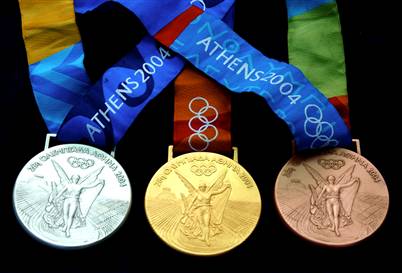
The medal ceremony was held half an hour later. He stood where he'd been helped up onto the top step while the anthem played, the crutches he'd been given by the medics were tucked at his side. A gold medal hung around his neck; he held the flowers the official gave him and congratulated the other two medallists and smiled and waved to the crowds like he'd always been told to do when he was a child.
As soon as the awards ceremony was over he moved to the sidelines as quickly as he could make his way through the people crowding him, past the cameras and the autograph seekers. Despite his leg and the pain, he pulled himself up and over the railing to the seats and made his way over to an old man up about five rows. People were patting his back as he passed, smiling at him, asking questions, taking pictures, wanting autographs. He ignored them all.
The television cameras caught the image of him kneeling awkwardly with his injured leg next to the old man as the gymnast handed over his flowers, lifted the medal from around his neck and placed it over his grandfather's head. The laurel wreath was placed next and the old man cried as he embraced his grandson.
He had wanted to compete forty years ago but had been prevented by the politics of the time. He spoke out against the government when it was dangerous to do so. Twenty years ago he had hoped his son would win for him, but John had gone another path. Now his grandson had done it as a gift. He wore the uniform of Romania with the country's name and flag on his chest. It had been his family's home and he had come back to please his grandfather. He competed using the family name, Grasu; no one would know who he was other than that he was the alternate to the team and he had a circus background and so hadn't competed much. He was just another faceless European athlete to the rest of the world.
He'd go back to America in a few days or a week and return to the life he'd built there, but for now he was Romanian, Rom, a Gypsy and he had beaten the best in the world. He had done it.
He had won.
"This is for you, Papa."
Return to Simon's